
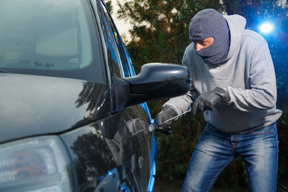
Fight Back Against Car Theft
A motor vehicle is stolen every 45 seconds in the United States. And that’s the good news—five years ago, a vehicle was stolen every 33 seconds.
Nearly half (45 percent) of stolen vehicles are never recovered. It’s not just your vehicle — thieves want the parts, too. Vehicle thieves can strip a vehicle in less than 30 minutes—and make two to four times a vehicle’s worth by selling its individual parts. The National Highway Traffic Safety Administration (NHTSA) reports the most popular items stolen from cars include engines, transmissions, air bags, radios, GPS units, iPods, laptops, and purses.
The NHTSA also says that nearly half of all auto thefts are due to driver error. It recommends the following simple safety measures:
- Take your key; don’t leave it in or on your vehicle.
- Close and lock all windows and doors when you park.
- Park in well-lit areas — in a garage, if possible.
- Never leave valuables in your vehicle, and especially in sight.
If you have a theft-prone vehicle, you can install anti-theft devices that will provide a further layer of protection to your car. A list of common devices and their costs follows.
Audible alarms: These typically have motion or impact sensors that trigger a 120-decibel siren.
Cost: $150 - $1,000
Benefits: Effective in preventing thefts, burglaries and vandalism
Steering column collars: These prevent thieves from “hot-wiring” the vehicle. Some collars are installed permanently. Others must be continuously activated.
Cost: $100 - $200 installed
Benefits: Excellent protection for older vehicles
Steering wheel locks: A metal bar, the steering wheel lock will prevent a steering wheel from turning. Must be re-installed every time the car is parked.
Cost: $25 - $100
Benefits: Excellent visual deterrent
Steering wheel/brake pedal lock: Prevents depression of the brake pedal.
Cost: $15 - $80
Benefits: Excellent visible deterrent
Wheel locks: Similar to the “boots” used by many large city police departments, tire locks prevent the vehicle from being driven.
Cost: $80 - $200
Benefits: Excellent visible deterrent
Tire locks/tire deflators: These attach to the tire valve stem and cause the tire to go flat if the tire rotates before they are removed
Cost: Under $50
Benefits: Easy and inexpensive to use
Theft deterrent decals: Theft deterrent decals visually warn thieves the vehicle is protected by an alarm or other antitheft devices.
Cost: $2 - $5
Benefits: Inexpensive but effective
Identification markers in or on vehicle: Security labels marking various vehicle parts enable the part to be identified if removed from the vehicle.
Cost: $2 - $15
Benefits: Inexpensive, discourage thieves from stealing the vehicle and aid in recovery
Window etching: Etching the vehicle identification number or other traceable number onto the vehicle’s windows makes it difficult for thieves to resell the vehicle or its parts.
Cost: Free to $100
Benefits: Discourages thieves from stealing the vehicle and aids in recovery
Laminated glass: Impact-resistant protective glazing applied to vehicle windows fortifies the windows against penetration or splintering.
Cost: Standard in some models
Benefits: Excellent protection for vehicle windows
Smart keys: Smart keys contain specially coded computer chips or radio frequencies. Without the exact key, the vehicle’s engine cannot be started.
Cost: Standard in some models
Benefits: Effective and extremely easy to use
Fuse cut-offs: Short circuit the electrical system, preventing the vehicle from starting.
Cost: $40 - $90
Benefits: Inexpensive and relatively easy to install
Kill switches: Kill switches inhibit the flow of electricity or fuel to the engine until a hidden switch is activated.
Cost: $10 - $125
Benefits: Inexpensive and relatively easy to install
Starter, ignition and fuel disablers: Short circuit the electrical or fuel system, preventing the vehicle from starting, or causing the vehicle to stop running within a short time.
Cost: Standard in some models
Benefits: Inexpensive and easy to use
Tracking devices: Most tracking devices are electronic transmitters hidden in the vehicle that emit signals to the police or monitoring stations when the vehicle is reported stolen.
Cost: $400 to $1,500
Benefits: Effective in recovery
Source: National Highway Traffic Safety Administration
Insurers often give discounts on your auto policy for the installation/use of certain protective devices. For more information, please contact us.
Minimize Your Water Damage Exposure
The information presented and conclusions within are based upon our best judgment and analysis. It is not guaranteed information and does not necessarily reflect all available data. Web addresses are current at time of publication but subject to change. SmartsPro Marketing and The Insurance 411 do not engage in the solicitation, sale or management of securities or investments, nor does it make any recommendations on securities or investments. This material may not be quoted or reproduced in any form without publisher’s permission. All rights reserved. ©2015 The Insurance 411. Tel. 877-762-7877. www.theinsurance411.com